
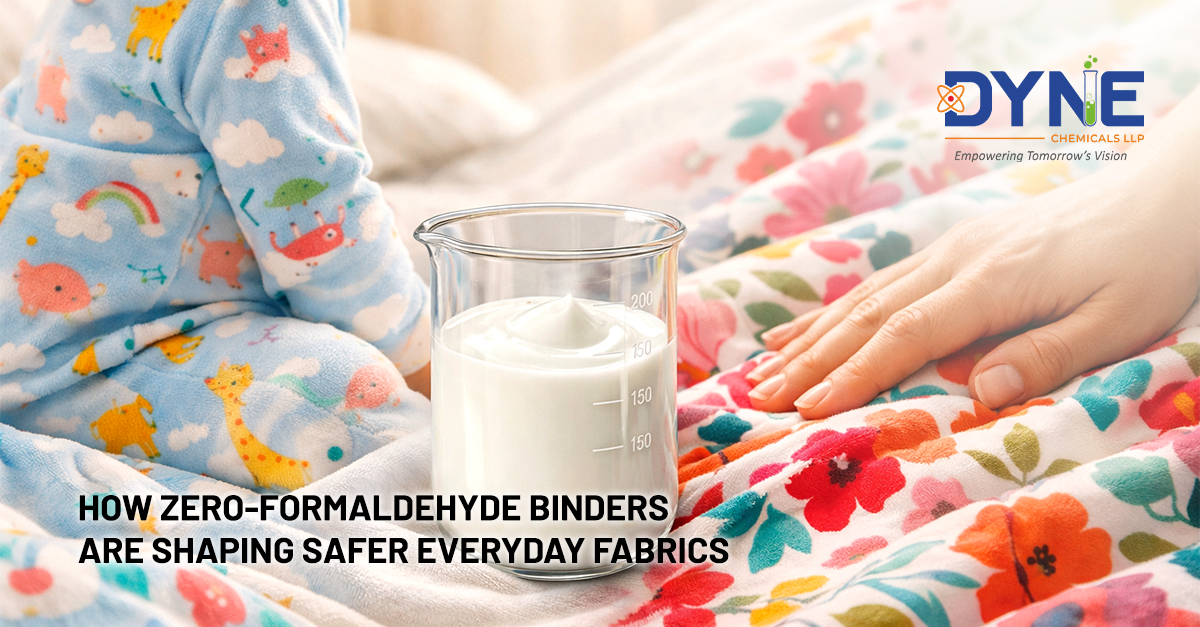
For decades, binders have played a silent but decisive role in how fabrics perform. They hold finishes in place, lock in durability, and ensure textiles behave the way designers and brands promise they will. Yet for something so foundational, binders rarely enter conversations around safety, comfort, or skin health. That is changing.
As awareness grows around chemical exposure in everyday products, and as global trade frameworks place renewed emphasis on compliance and transparency, zero-formaldehyde binders are emerging as a meaningful shift in how textiles are engineered.
From kids’ fashion to bedding and upholstery, safer binder chemistry is fast becoming a baseline expectation.
Why Formaldehyde Remains a Concern Even in a Regulated World
Formaldehyde has long been used in textile finishing, particularly for wrinkle resistance, durability, and performance coatings. Regulations across markets now strictly limit free formaldehyde levels in finished fabrics, and compliance testing is routine. So why does the issue persist? The answer lies in exposure context, not just regulatory thresholds.
Even when formaldehyde content falls within permissible limits, sensitive users like infants, children, and individuals with allergies or compromised skin barriers can still experience irritation. Prolonged skin contact, warmth, sweat, and friction can amplify these effects. In enclosed spaces, the gradual release of residual chemicals into the air may also contribute to odour retention and discomfort.
This distinction has become particularly relevant as textile exports increasingly serve markets where consumer safety expectations extend beyond minimum compliance.
Skin-Safety Scrutiny with a Lens on EU and US Buyers
Recent trade developments (including India’s historic trade deal with EU and an interim trade framework with the US) have sharpened focus on chemical safety and traceability across the textile value chain.
For buyers in the EU and the US, skin safety is closely examined. In these markets, questions increasingly go beyond “Is this compliant?” to “Is this chemistry inherently safer?”
Even trace contributors to irritation, odour, or chemical release can trigger reformulation demands or sourcing shifts.
Zero-formaldehyde binders offer brands and manufacturers a way to reduce risk at the formulation stage itself, rather than relying solely on downstream testing and corrective action.
Binders and the Sensory Experience of Fabric
Binders influence far more than durability. They shape how a fabric feels, smells, and behaves against the skin.
Key areas impacted by binder chemistry include:
Odour profile
Residual formaldehyde or formaldehyde-releasing systems can contribute to persistent chemical odours, particularly noticeable in bedding, upholstery, or garments worn close to the body. Zero-formaldehyde binders help reduce these off-notes, resulting in cleaner-smelling textiles from production through end use.
Hand-feel and softness
Traditional binder systems may stiffen fabrics or leave a slightly harsh surface, especially after repeated washing. Modern zero-formaldehyde binders are designed to deliver film strength without compromising softness, helping fabrics retain a more natural drape and touch.
Skin compatibility
Skin irritation is rarely caused by a single factor. It is the cumulative effect of friction, heat, moisture, and chemical interaction. Binders that eliminate formaldehyde reduce one significant variable from this equation, particularly important for garments and textiles designed for long wear or sleep.
In applications where comfort is not optional, binder choice becomes a frontline decision.
Why Brands Are Moving Toward Inherently Safer Chemistry
The shift toward zero-formaldehyde binders is not driven by regulation alone. It reflects a broader recalibration of how brands define responsibility and quality.
Three forces are converging:
Consumer awareness without technical language
Consumers may not ask about binders explicitly, but they do ask for “non-irritating,” “skin-friendly,” and “safe for children.”
Global market alignment
As India’s exports to the EU and US grow, brands are aligning formulations to the strictest common denominator rather than adapting market by market. Inherently safer chemistry simplifies compliance and reduces friction in buyer approvals.
Risk mitigation beyond compliance
Forward-looking brands are designing products that sit comfortably below regulatory thresholds.
In this context, zero-formaldehyde binders go beyond meeting a rule help addressing evolving market and customer preferences.
Skin-Contact Applications Where the Difference Is Most Visible
The advantages of zero-formaldehyde binders are most evident in textiles that remain in prolonged contact with skin. In kidswear and infant textiles, they help minimise irritation on sensitive skin. Loungewear and inner layers benefit from improved comfort, reduced odour, and better wearability in warm conditions. In bedding and home textiles, they support cleaner sleep environments by limiting residual chemicals. For upholstery, lower chemical release improves indoor air quality without compromising durability.
Dyne’s Zero Formaldehyde Product Range
Dyne Chemicals offers a portfolio of zero-formaldehyde binder systems engineered to support:
· Skin-contact applications where irritation risk must be minimised
· Export-oriented textiles aligned with EU and US buyer expectations
· Consistent processing behaviour without reliance on formaldehyde-based crosslinking
· Clean odour profiles and balanced hand-feel across wash cycles
By addressing safety at the formulation stage, Dyne enables manufacturers and brands to meet evolving global scrutiny without compromising on durability or process efficiency.
Redefining Performance in Everyday Fabrics
Performance has traditionally been measured in wash fastness, abrasion resistance, and longevity. Those parameters still matter but they no longer tell the whole story.
Today, performance also means, how a fabric feels after months of use, whether it retains a neutral odour, how it interacts with sensitive skin, how confidently it passes buyer audits across markets.
Zero-formaldehyde binders represent a quiet but decisive evolution in textile chemistry, one that aligns technical performance with human experience. And so, for fabrics that remain closer to the body, the chemistry behind them must move closer to the values global markets increasingly demand.

Mr. Yash Patel
Yash has spent over a decade and a half working in the manufacturing and marketing of textile-based printing inks, binders, auxiliaries and specialty chemicals. He combines deep technical understanding with an entrepreneurial vision to build sustainable and globally competitive textile chemical solutions.
View Full Bio