
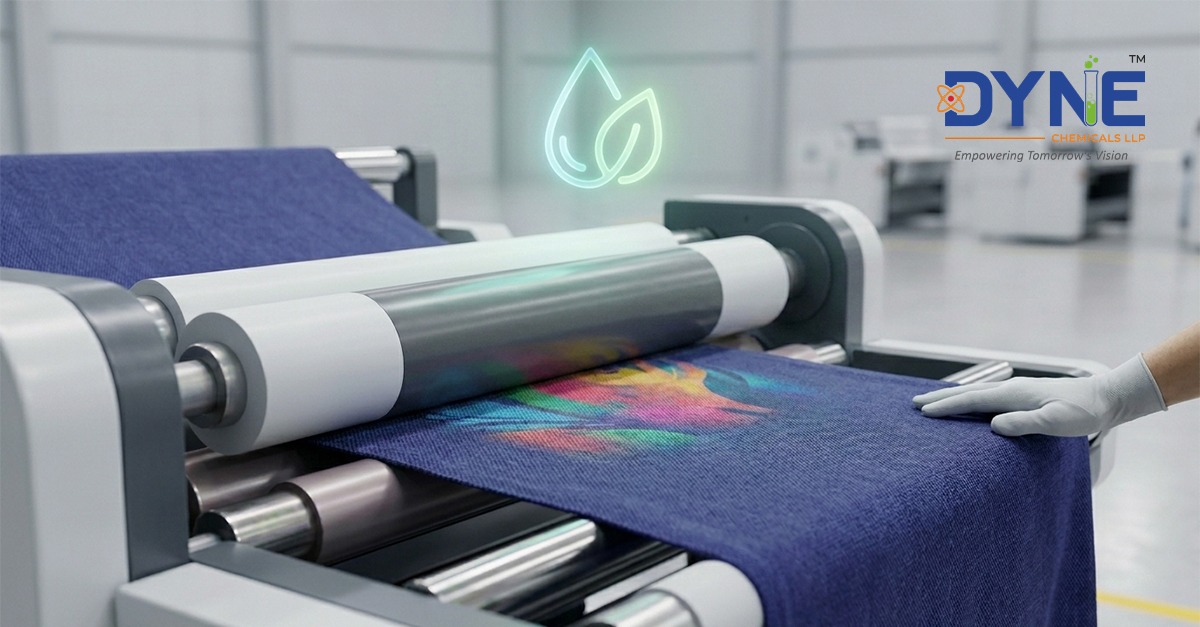
If you print on dark cotton regularly, you already know the challenge.
Getting bright shades is one thing. But getting them without building film, compromising hand-feel, increasing wash load, or inviting buyer questions around chemical compliance? That’s where the real challenge begins.
For decades, discharge printing had been the preferred route for achieving soft, vibrant prints on dark fabrics. And for good reason.
Unlike surface printing methods that build colour on top of the fabric, discharge works within the fibre itself, removing the base dye and replacing it with a new colour. The result is what brands and processors have always valued most:
As the comparison shows, dry discharge printing combines premium output with simplified processing, zero post-print water consumption, and stronger sustainability credentials.
- Surface-free softness
- High colour vibrancy
- Excellent wash durability
- Faster production cycles
- Lower resource consumption
- Cleaner shop-floor environments
- Safer chemical handling
- Easier compliance with global buyer standards
- Greater consistency across commercial-scale production
So What Changes with Dry Discharge?
Modern dry discharge printing preserves the visual and tactile advantages that made discharge valuable in the first place, while aligning far better with what today’s textile floor demands. It brings together:- Premium print clarity
- Soft, natural fabric feel
- Zero process water consumption after printing
- Cleaner shop-floor processing
- Faster workflow integration
- Better alignment with global compliance frameworks
Dry Discharge vs Other Printing Routes
When choosing a printing route, the real comparison is not just visual output, but the total process.| Feature | Traditional Discharge | Dry Discharge | Pigment Printing |
|---|---|---|---|
| Fabric Feel | Soft | Ultra-soft | Can feel stiff |
| Water Usage | High | Zero | Moderate |
| Process Workflow | Multi-stage | Simplified | Simplified |
| Post-Wash Requirement | Required | Not Required | Not Required |
| Shop-Floor Odour | Process-dependent | Zero odour | Moderate |
| Export Compliance Alignment | Variable | High | Moderate |
| Best Use Case | Dark cotton | Premium, sustainable production | Light to medium shades |
When Should You Use Dry Discharge Systems?
1. When You Are Printing on Dark Fabrics
If your base shades include black, navy, charcoal, maroon, or other deep reactive shades, conventional pigment systems often need heavier deposition to achieve brightness. Dry discharge creates colour from within the fibre, allowing brighter shades without building unnecessary film.2. When Hand-Feel Is Part of the Product Promise
For premium T-shirts, fashion basics, kidswear, loungewear, and lifestyle apparel, hand-feel is part of the sale. Dry discharge helps preserve the natural softness and breathability of cotton while delivering vibrant print effects.3. When EU and US Buyers Are Asking Tougher Questions
Recent trade momentum with Europe and evolving sourcing frameworks with North America are making chemical transparency a bigger part of vendor conversations. Buyers increasingly examine:- Restricted substance compliance
- Chemical traceability
- Water consumption
- Worker safety
- Process sustainability
4. When Wash Durability Cannot Be Negotiated
Because discharge works within the fibre rather than on top of it, colours stay vibrant even after repeated laundering, which is an important advantage for retail, export, and private-label manufacturers.Dyne’s Ecological DD100/200 Dry Discharge Series
Dyne’s certified Ecological DD100/200 Dry Discharge Series offers a cleaner alternative to conventional discharge systems. It delivers:- An eco-compliant activator with no chlorine and no safoline
- Zero odour processing for a cleaner shop-floor environment
- A Print–Dry–Cure workflow, similar to pigment printing
- No washing requirement after curing, enabling zero process water consumption while simplifying production
- Excellent softness, brightness, and batch-to-batch consistency
- Alignment with the compliance expectations of EU and US buyers (GOTS, OEKO-TEX, and ZDHC standards)
Why the Right Textile Chemical Partner Matters
The quality of your discharge print is only as strong as the chemistry behind it. The right textile chemical supplier brings:- Reliable, batch-to-batch formulations
- Technical support that works on real production floors
- Chemistry aligned with global buyer expectations
- Solutions designed for commercial-scale consistency
Quick Reality Check: Is Dry Discharge Right for You?
Ask yourself:- Are you printing regularly on dark reactive-dyed cotton?
- Is soft hand-feel critical to your product positioning?
- Are your buyers asking tougher sustainability or compliance questions?
- Are water-intensive workflows, washing loads, or process time becoming operational concerns?
- Do you want discharge-quality aesthetics without discharge-era inefficiencies?
FAQs
Yes. Systems designed around a Print–Dry–Cure workflow can easily be integrated with minimal disruption, allowing processors to achieve discharge effects without introducing separate washing stages.
A block silicone softener releases its softening action gradually and in a controlled way during curing, giving manufacturers more predictable and even results. Regular unblocked silicone can release its effect too quickly, which can sometimes cause an uneven or greasy feel if not handled carefully.
Dry discharge printing works best on natural fibres, especially 100% cotton. It requires reactive-dyed fabrics where the base dye can be chemically removed. Synthetic fibres like polyester are generally not suitable.
Yes. That’s one of its biggest advantages over traditional discharge methods. Modern dry discharge systems use low-toxicity formulations that comply with international eco-standards, making them safer for workers while eliminating post-print wastewater generation from the discharge stage.
It can. Cleaner chemistry, zero post-print water consumption, and lower process emissions help support the sustainability and compliance conversations increasingly expected by EU and US buyers.
Both are more eco-friendly than plastisol printing. However, discharge printing produces a softer hand-feel and is better for dark fabrics. Water-based inks work better on light fabrics and are easier to set up for small runs.
Absolutely. Many premium brands combine discharge printing with pigment or water-based overprints to create multi-colour, multi-texture designs. This is known as a discharge overprint technique.
In many setups, it actually helps increase production speed. Removing post-wash stages can simplify workflow, reduce handling, and improve overall line efficiency.
Look for proven print performance, batch consistency, technical support, and chemistry designed for modern compliance, not just visual output.
Look for a textile chemical supplier that offers dedicated discharge systems with technical support, eco-certifications, and proven performance at scale. Dyne Chemicals offers the Ecological DD100/200 range, designed specifically for sustainable, high-quality discharge printing in modern textile manufacturing.

Mr. Yash Patel
Managing Partner, Dyne Chemicals LLP
15+ Years of Experience
Yash has spent over a decade and a half working in the manufacturing and marketing of textile-based printing inks, binders, auxiliaries and specialty chemicals. He combines deep technical understanding with an entrepreneurial vision to build sustainable and globally competitive textile chemical solutions.
View Full Bio