
The right textile chemistry can significantly influence reactive digital printing performance, efficiency, and sustainability. It supports colour strength, print definition, fabric penetration, softness, and dependable fastness while helping reduce rework, water consumption, and chemical waste.
For mills working with reactive digital printing, chemistry plays a role across the process. From fabric preparation and digital printing to post-print washing-off. The key is not simply choosing individual chemicals, but matching each one to the stage and performance requirement where it matters.
Why Chemistry Is a Key Driver Behind Reactive Digital Print Quality
A digital printer provides precision in ink deposition, but the final result also depends on how the fabric receives and processes that colour.
Fabric absorbency, liquor penetration, dye–fibre bonding, and washing-off all influence the final print. Get these variables right, and the result can be brilliant colour, crisp definition, uniform appearance, and reliable fastness. Get them wrong, and even sophisticated equipment can produce uneven colour development, poor penetration, inconsistent print definition, or inadequate fastness.
This makes application-specific textile chemistry an important part of the reactive digital printing process.
Getting Reactive Digital Printing Right
Reactive digital printing is particularly suited to cotton, rayon, and other cellulosic substrates, where the dye chemically bonds with the fibre during fixation. Achieving deep, even shades therefore depends on controlled fabric preparation as well as effective post-print processing.
Dyne Chemicals addresses these requirements through a combination of products designed for specific stages of the process.
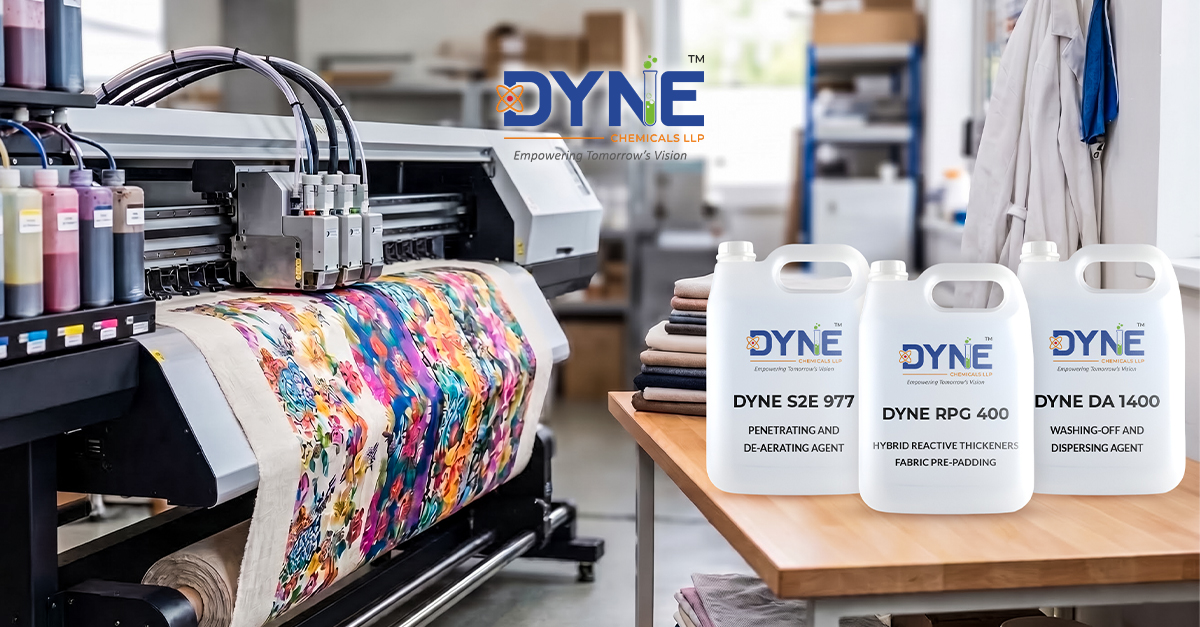
Dyne RPG 300 and RPG 400 are hybrid reactive thickeners designed for digital printing applications as well as fabric pre-padding. Their dual application supports the viscosity and flow behaviour required for controlled digital printing while giving processors flexibility across preparation and printing stages.
For fabric preparation, Dyne S2E 977 is a penetrating and de-aerating agent that helps the padding liquor spread evenly through the fabric while addressing trapped air.
After printing, Dyne DA 1400, a washing-off and dispersing agent, helps remove unfixed colour and unwanted residues, supporting clean processing and the required fastness.
Together, these products address distinct requirements across the reactive digital printing workflow, from pre-padding and digital printing to post-print washing-off.
Where Better Chemistry Improves Process Efficiency
The value of reactive digital printing chemistry extends beyond the appearance of the finished fabric.
Better fabric preparation can reduce variability before printing begins. Effective penetration and de-aeration can support more uniform preparation, while efficient washing-off can help achieve the required cleanliness with fewer processing passes.
The practical implications include:
- Fewer print defects and reprints
- More consistent shade development
- More efficient washing-off
- Reduced water and energy demand during post-print processing
- Lower chemical and fabric wastage
In other words, chemistry can influence not only what the print looks like, but also how efficiently the production process reaches that result.
Why Sustainability Is Becoming Part of the Chemistry Decision?
For textile manufacturers, sustainability is increasingly connected to process efficiency.
Every unnecessary reprint consumes additional fabric, dye, water, energy, and production time. Likewise, inefficient washing-off can increase resource consumption without improving the finished textile.
That makes process chemistry part of a wider sustainability equation. The objective is not to trade performance for sustainability, but to achieve both through better control of the printing process.
Choosing Chemistry for the Reactive Digital Printing Process
As reactive digital textile printing continues to expand, the role of chemistry will become increasingly application-specific.
A mill running reactive digital printing on cotton has requirements that differ across fabric type, process stage, and required end performance. The chemistry therefore needs to be selected according to the substrate, process stage, and required end performance.
The underlying principle is simple: digital printing technology can only perform as consistently as the chemistry and process conditions supporting it.
When those elements are engineered to work together, better print quality can go hand in hand with greater process efficiency and more responsible textile manufacturing.
From fabric preparation to post-print washing-off, Dyne Chemicals takes care of the chemistry behind every stage of reactive digital printing. Contact Dyne Chemicals to discuss the right combination of products for your mill’s specific requirements.
FAQs
Reactive digital printing uses specialised dyes along with chemistry for fabric preparation and post-print processing. Dyne’s portfolio includes RPG 300 and RPG 400 for digital printing applications and fabric pre-padding, S2E 977 for penetration and de-aeration during pre-padding, and DA 1400 for washing-off and dispersing after printing.
Reactive digital printing uses specialised dyes along with chemistry for fabric preparation and post-print processing. Dyne’s portfolio includes RPG 300 and RPG 400 for digital printing applications and fabric pre-padding, S2E 977 for penetration and de-aeration during pre-padding, and DA 1400 for washing-off and dispersing after printing.
Pre-padding helps establish controlled and uniform fabric conditions before ink application. Appropriate pretreatment and pre-padding chemistry can support consistent ink reception, penetration, and print uniformity.
Appropriate chemistry can help improve fabric preparation, reduce process variability, minimise reprints, and optimise post-print washing-off. This can contribute to lower water, energy, chemical, and fabric consumption across the process.
Yes. Better process control can reduce reprints and rejects, while efficient washing-off chemistry can help reduce water and energy requirements in reactive digital printing. The sustainability benefit therefore comes not simply from an individual chemical, but from how the chemistry improves the overall process.
Dyne’s portfolio for reactive digital printing includes RPG 300, RPG 400, DA 1400, and S2E 977, addressing requirements from fabric pre-padding and digital printing through to post-print washing-off.
Uneven fabric preparation can contribute to inconsistent digital print results. In pre-padding, factors such as inadequate liquor penetration or trapped air can affect uniformity. Dyne S2E 977, a penetrating and de-aerating agent, is designed to support more even padding liquor distribution and address trapped air during fabric preparation.

Mr. Yash Patel
Yash has spent over a decade and a half working in the manufacturing and marketing of textile-based printing inks, binders, auxiliaries and specialty chemicals. He combines deep technical understanding with an entrepreneurial vision to build sustainable and globally competitive textile chemical solutions.
View Full Bio