
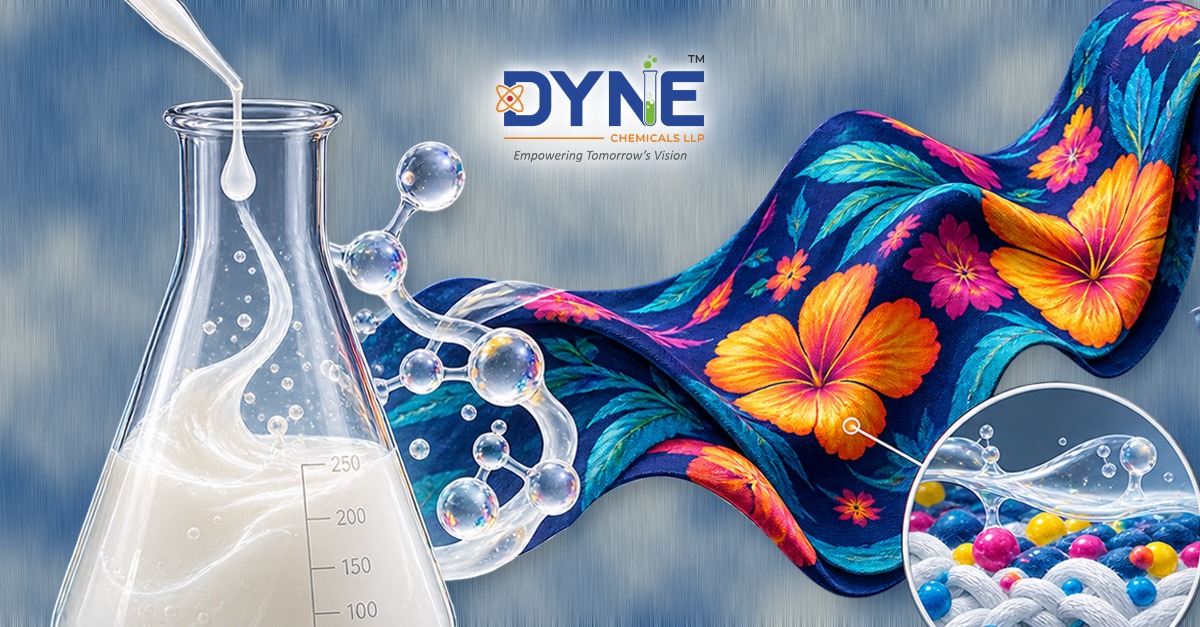
A pigment print can look perfect when it leaves the printing floor. That, however, is only the beginning of its performance story. The more meaningful question is what remains after repeated washing, mechanical stress and everyday use. Does the colour retain its depth? Does the print remain intact? Does the fabric retain its intended hand feel?
For pigment printing, these questions bring the textile binder into sharper focus. Pigments do not inherently bond to textile fibres in the way reactive dyes do. Their durability therefore depends significantly on the binder system that anchors the pigment to the substrate. Research has shown that binder type, formulation and process parameters can materially influence washfastness and crockfastness in pigment-printed fabrics.
This makes wash durability less a matter of adding more binder and more a question of achieving the right balance between adhesion, film formation, flexibility, curing and fabric feel.
Wash Durability Is a Formulation Challenge
The performance of a pigment print is governed by what happens when the binder forms its film around and between pigment particles during fixation.
A binder needs to create sufficient adhesion to withstand repeated laundering and mechanical action. At the same time, the resulting film cannot simply become harder or heavier in pursuit of durability. Excessive film formation can influence softness, flexibility and feel of the fabric.
This is the fundamental challenge in developing high-performance pigment printing binders. That durability cannot be considered in isolation.
A commercially useful binder has to answer several questions simultaneously:
- Can it retain colour through repeated washing?
- Can it withstand mechanical stress without visible cracking or crocking?
- Can it maintain an acceptable soft hand feel?
- Can it perform consistently across the intended substrate?
- Does its chemistry align with increasingly demanding chemical-management expectations?
The last question is becoming increasingly relevant as global textile supply chains place greater attention on chemical inputs. ZDHC, for example, specifically identifies APEOs such as NPEO and OPEO among substances relevant to textile processing and restricts their intentional use in formulations.
So the next generation of textile binders is being evaluated not simply on whether a print survives a wash test, but on the wider performance profile of the chemistry.
Introducing Dyne Bind 50 Eco
We developed Dyne Bind 50 Eco around precisely this real-world performance question and put it through a demanding test.
In Dyne’s test, the binder was evaluated on 100% polyester fabric through 10 wash cycles at 60°C, with one of those cycles incorporating a ball wash to introduce additional mechanical stress.
The reported result was notable: full shade retention, no visible crocking, no visible cracking and a soft fabric hand feel after the test.
In other words, the objective was not simply to demonstrate that the print could survive laundering. It was to test whether durability could coexist with the tactile quality expected from the finished textile.
For uniforms and workwear, repeated washing is part of the operating environment. For activewear, laundering and mechanical movement are routine.
For other commercial textile applications, wash durability can directly influence how long a print continues to look fit for purpose.
In such applications, wash-resistant pigment printing is part of the product specification.
Why Polyester Makes the Test More Interesting
Polyester presents a particularly relevant substrate for pigment printing because pigment systems offer a versatile route for applying colour without relying on fibre-specific dye chemistry.
But versatility does not remove the performance challenge. The binder still has to establish a durable interface between the pigment and the textile surface, while the finished print must withstand the mechanical and thermal stresses associated with laundering and use.
That is why testing conditions matter.
A single wash can demonstrate whether a print survives. Repeated washing begins to reveal whether the formulation has genuine durability. And mechanical stress can reveal something different again.
Beyond Wash Fastness
Dyne Bind 50 Eco is a pigment printing binder formulated for demanding prints, combining strong and durable prints with soft hand feel. Its stated formulation characteristics include being NPEO/APEO-free, odourless and water-miscible, alongside being a zero formaldehyde binder and offering broad substrate compatibility.
That combination reflects a broader shift in textile chemistry where performance is increasingly becoming multidimensional. A binder is expected to contribute to print durability while fitting into a chemical-management framework that increasingly scrutinises substances used during manufacturing.
For global textile producers and exporters, chemistry therefore has to satisfy both the performance specification and the chemical specification.
This is particularly relevant for manufacturers supplying markets where buyers assess restricted substances, chemical transparency and product safety alongside conventional quality parameters.
Rethinking What a Durable Print Means
The future of pigment printing is unlikely to be defined by maximum binder loading or by durability considered as a single number. The more meaningful benchmark is balanced performance. It should also fit the realities of modern production and evolving chemical expectations. That is exactly what Dyne Bind 50 Eco is designed to deliver.
FAQs
A binder forms the film that anchors pigment particles to the textile substrate. Its formulation has a significant influence on properties such as adhesion, washfastness, crockfastness and hand feel.
A binder forms the film that anchors pigment particles to the textile substrate. Its formulation has a significant influence on properties such as adhesion, washfastness, crockfastness and hand feel.

Mr. Yash Patel
Yash has spent over a decade and a half working in the manufacturing and marketing of textile-based printing inks, binders, auxiliaries and specialty chemicals. He combines deep technical understanding with an entrepreneurial vision to build sustainable and globally competitive textile chemical solutions.
View Full Bio